Cloud computing careers in 2026 are exploding and evolving into new specializations. Remember when storing files meant a bulky external hard drive and software lived solely on your computer? That world is being steadfastly replaced by the complex interconnected realm of multi-cloud. From streaming your favorite show to collaborating on a global project, cloud computing is the invisible engine powering our modern lives. This fiercely transforming multi-cloud environment requires skilled engineers, architects, and strategists to keep it running. The demand for cloud talent isn't just growing; it's exploding, and evolving into new specializations that promise challenge, impact, and excellent compensation.
So, what does the horizon hold? Let’s map out the practical steps you can take today to land one of these high paying cloud computing career paths in 2026.
Before we dive into the roles, let’s ground ourselves in the numbers. According to
Gartner, cloud will become a business necessity by 2028 and this rapid adoption shows no sign of slowing down. Meanwhile, an Indeed report has consistently ranked cloud computing among the top in-demand tech skills, with roles often staying open longer due to a talent shortage. This isn't a bubble; it's a fundamental shift in how business and technology operate. Pursuing cloud computing career paths now means positioning yourself at the center of this massive digital transformation for years to come.
The cloud landscape is transforming fast-from moving beyond basic migration to sophisticated optimization, security, and innovation. If you are planning to launch a rewarding career in cloud computing in 2026, have a look at the most high-paid cloud computing jobs and cloud skills required for 2026
As companies scale their cloud usage, costs can spiral unpredictably. This is where the role of Cloud FinOps (Financial Operations) Analyst becomes crucial. The role of a Cloud FinOps Analyst demands proven skills and expertise in finance, technology, and business strategy.
A Cloud FinOps Analyst acts as a translator between engineering teams and the CFO, ensuring every cloud dollar is justified and optimized. These professionals use specialized tools to monitor various aspects of the cloud infrastructure- spending, identify waste, and implement cost-saving strategies.
Even clouds couldn’t escape the AI revolution. AI/ML cloud engineers are required to have specializations in building and managing the complex cloud infrastructure. Today cloud engineers closely work with the data scientists to design MLOps pipelines, select the right GPU instances, manage data lakes, and ensure models can be deployed and scaled reliably. All these attributes make AI/ML Cloud Engineer as one of the most high-paying cloud jobs in 2026.
Security is always a top concern, but the focus is shifting. As architectures become more complex with containers, serverless functions, and microservices, a new breed of security expert is now the need of the hour. A Cloud-Native Security Engineer doesn't just bolt on security at the end; they bake it into the CI/CD pipeline (this is called "DevSecOps"). Cloud security experts are required to have expertise in tools like container scanning, infrastructure-as-code (IaC) security analysis, and zero-trust network models within cloud environments. With cyber threats growing sophisticated, the role of a cloud security engineer is now mission-critical.
With data centres expanding exponentially, the growing environmental concern is now under scrutiny. This rising concern has fueled the need for Cloud Architects who can not only design performance and cost but also energy efficiency. The rising demand for sustainability-focused cloud architects who can understand the carbon footprints of different cloud regions, and optimize services and architectures accordingly are in huge demand.
With cloud moving rapidly to the ‘edge’- exactly where data is created (like companies, smart cities, or retail stores). An Edge Computing Integration Specialist is responsible for designing hybrid systems that seamlessly connects the edge devices (IoT and smart cameras) with centralized cloud platforms.
Wondering how to get started to apply for these modern cloud computing roles? Here is your step-by-step guide.
Your dream to launch a rewarding cloud career depends on your foundational strength. Remember, skyscrapers can't be built on sand. Enroll in a structured
cloud foundational course to validate your foundational skills.
Theory is useless without practical implementation. Your next step in the learning process must include building projects, using real-world tools and platforms.
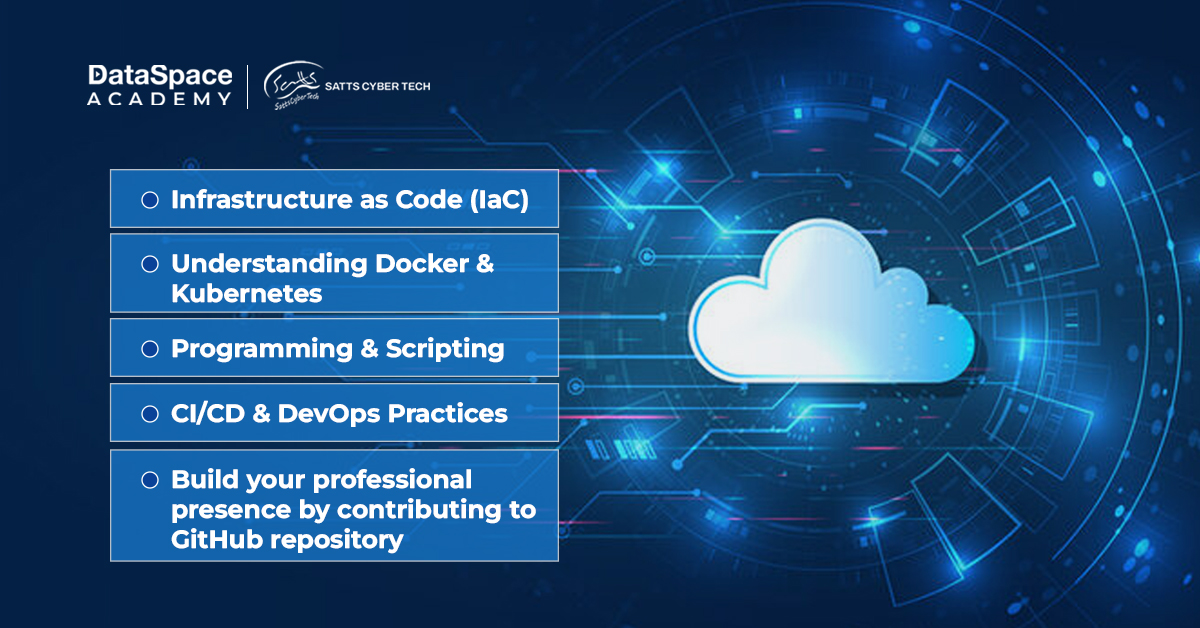
The future of cloud belongs to those with high-value skills, such as:
Corporate-ready skills are non-negotiable in the fiercely competitive job market. So it is important to invest in excelling your
business communication skill as companies prioritize candidates who can effortlessly coordinate in teams and cross-functional activities. Strong problem-solving is also vital as you'll often need to explain complex technical issues to non-technical stakeholders.
Launching cloud computing careers in 2026 demands upskilling, second by curiosity and a passion for solving complex problems. Remember, continuous learning and real-world application with latest cloud innovation is the key to become cloud-ready in 2026. It’s time to invest in outcome-driven learning that drives your cloud dream forward with DataSpace Academy’s expert-curated cloud computing course.
Absolutely! The key lies in structured learning. Start with a foundational cloud computing course or an entry-level certification to grasp the core concepts. Then, focus on building hands-on projects. Your diverse skills and perspective can actually be your advantage in understanding business needs and user experiences.
AWS currently holds the largest market share (around 33%), making its skills widely in demand. A practical strategy is to start with one (AWS is often recommended for its breadth of learning resources) to understand core cloud paradigms. Once you're proficient in one, learning a second becomes easier, making you more versatile.
Yes, when combined with practical skills. Certifications provide a validated, structured learning path and help your resume pass through automated filters (ATS) and catch a recruiter's eye. They signal commitment and foundational knowledge. The winning combination is a relevant certification plus a GitHub portfolio with real projects you can discuss in an interview.
Continuous Learning & Curiosity. The cloud ecosystem changes at a dynamic pace. The most successful professionals are those who upskill, experiment with new technologies, and adapt to latest practices.



 Loading...